Why Coaches Need Wearable Data to Prevent Injuries
Most soft-tissue injuries in team sports don't happen in a single catastrophic moment — they happen at the end of a three-week period where cumulative load quietly exceeded the athlete's recovery capacity. The injury manifests suddenly, but the conditions for it were building for weeks. This is the fundamental problem that wearable data solves: it makes the invisible visible before the consequences become unavoidable.
The conventional injury-prevention toolkit — RPE surveys, GPS load monitoring, movement screens — captures important data but has two shared limitations. First, subjective measures like RPE are distorted by the same competitive instincts that make athletes push through warning signs. Second, external load metrics like GPS distance don't account for internal load — two athletes can run the same distance with very different physiological cost depending on their recovery state that day. HRV-based wearables measure internal load directly.
In practice, the most predictive signal isn't a single bad recovery score — it's a sustained downward trend over 5–7 days paired with maintained or increased training intensity. An athlete whose recovery score drops from 80% to 65% to 55% across a week while continuing to train at full intensity is in a high-risk window. Identifying that pattern in time to adjust load is where wearable data pays off most clearly.
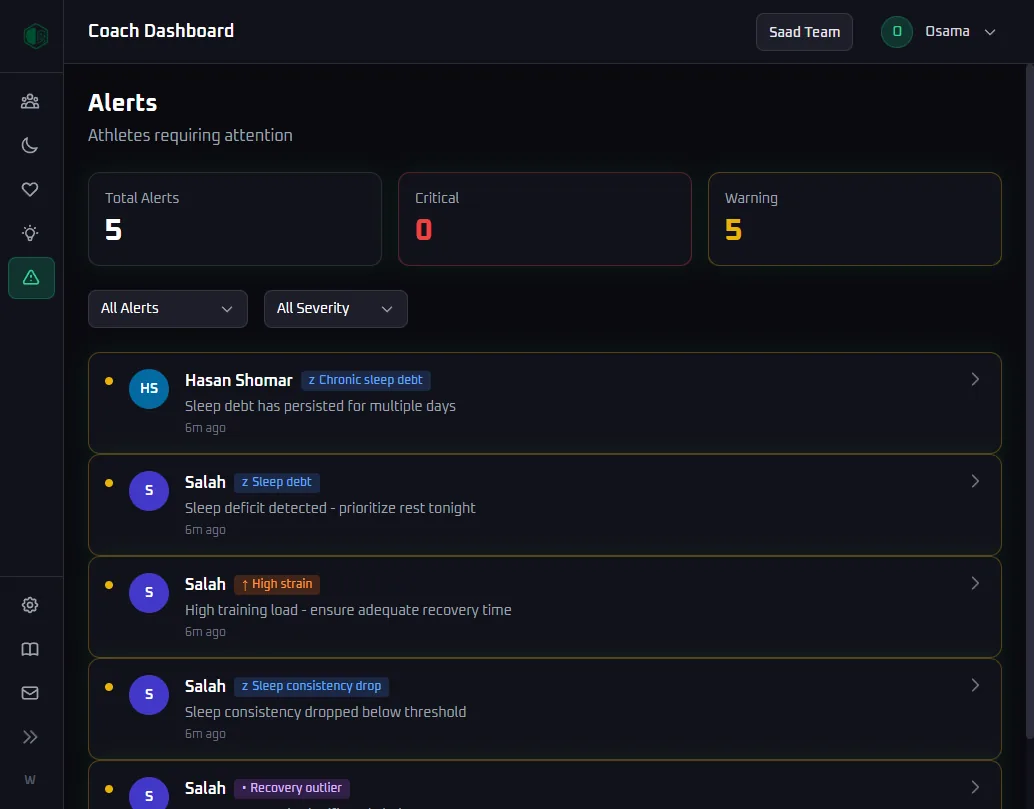
The barrier for most coaching staffs hasn't been willingness — it's been tooling. Individually reviewing five, ten, or twenty athletes' WHOOP data every morning is not practical. Vector Connect removes that barrier by aggregating the data into a roster view with automatic alerts, making wearable-informed coaching scalable to team sports for the first time without requiring a dedicated sports scientist to process the numbers.
Ready to put this into practice?
Join the Vector Connect waitlist and be first to coach and train with real WHOOP data.
Join Waitlist