VC logo
← Back to Blog
Training

The ACWR Rule: How Much Training Load is Too Much

Vector Connect Team·2026-04-03·5 min read

The acute-to-chronic workload ratio is one of the few sports science metrics with real injury data behind it. It came out of rugby league research in the mid-2010s and has since been replicated across football, basketball, and cricket. The idea is simple: compare an athlete's training load over the last seven days (acute) to the rolling average of the past 28 days (chronic). Divide the two, and you get a ratio that tells you whether training intensity has shifted faster than the body has had time to adapt.

The window that consistently shows the lowest injury rate across studies is 0.8 to 1.3. Stay inside that band and the injury curve stays flat. Step above 1.5, and the probability of a soft-tissue injury in the following week climbs sharply — some studies show it doubling or tripling. Drop below 0.8, and you're detraining, which carries its own injury risk when intensity resumes. The sweet spot is keeping the ratio close to 1.0, meaning this week looks roughly like the last four weeks.

The practical value isn't in the ratio itself — it's in seeing the trend line early. An athlete creeping from 1.1 to 1.35 to 1.55 over three weeks has given you a two-week warning before anything goes wrong. Most coaches never see this signal because manually calculating ACWR across a roster every day is the kind of admin work that only survives if someone is paid full-time to do it.

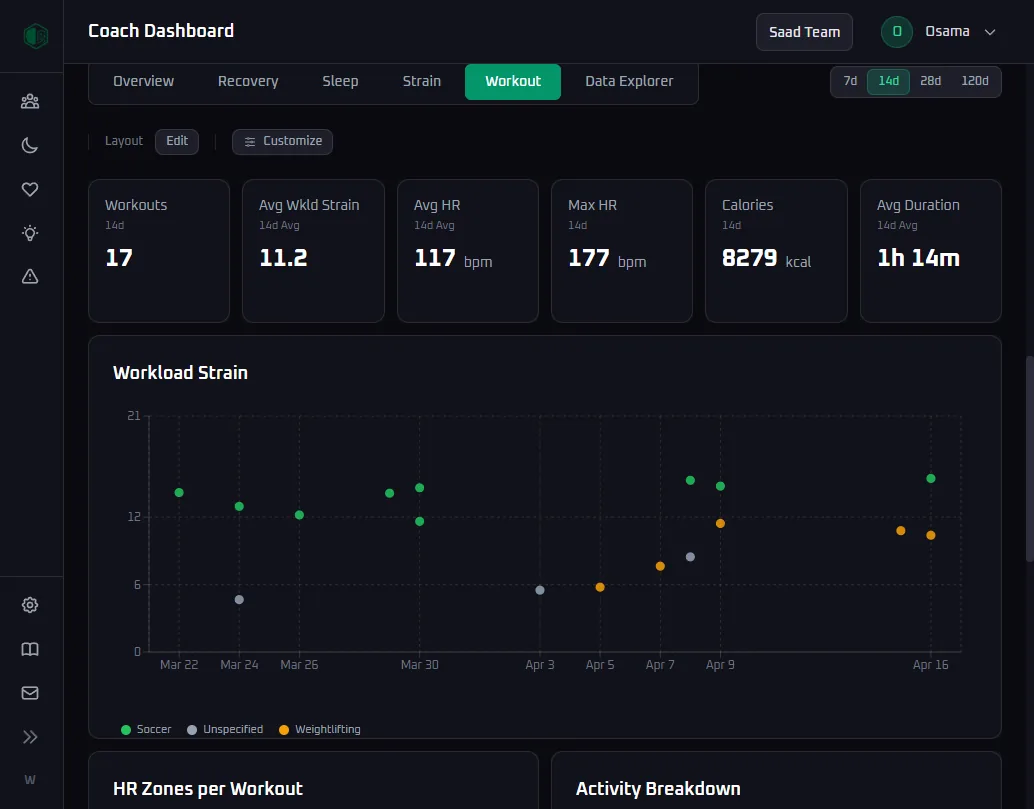
Vector Connect surfaces ACWR per athlete directly on the dashboard, color-coded by zone. Red means intervention this week, yellow means conversation before Friday, green means keep going. The point isn't to treat the number as a hard rule — it's to catch the trajectory before it becomes a problem, while there's still time to adjust the plan.

Ready to put this into practice?

Join the Vector Connect waitlist and be first to coach and train with real WHOOP data.

Join Waitlist